Tsinghua University

LXYang Research Group, Physics Department, Tsinghua University

Electronic Structure of Quantum Materials

  • HOME
  • RESEARCH
  • MEMBERS
  • TECHNIQUES
  • PUBLICATIONS
  • NEWS
Group Logo

Comparison between nickelates and cuprates

Dichotomy in Low- and High-Energy Band Renormalizations in Trilayer Nickelate La₄Ni₃O₁₀ : A Comparison with Cuprates

Physical Review Letters 135, 146506 (2025)

By combining ARPES with theoretical calculations, we reveal a dualistic band renormalization in La₄Ni₃O₁₀ relative to cuprates. At high energies, strong correlation induces waterfall-like renormalization in both systems, but at low energies, the characteristic kinks observed in cuprates are absent in La₄Ni₃O₁₀. This indicates negligible electron–phonon coupling, underscoring the central role of strong correlation in nickel oxide superconductivity.
La4Ni3O10 vs cuprates
Learn More

Progress on Correlated Electronic Structure in Chromium-based Kagome Superconductors

Electron Correlation and Incipient Flat Bands in the Kagome Superconductor CsCr₃Sb₅

Nature Communications 16:3229 (2025)

We systematically studied the electronic structure of CsCr₃Sb₅ using ARPES and first-principles calculations. First-principles calculations show that CsCr₃Sb₅ retains the fundamental electronic structure characteristic of kagome materials. Compared with CsV₃Sb₅, the van Hove singularities and Dirac points are located farther from the Fermi level, while the flat band is situated closer to the Fermi level. The consistence between ARPES experiment and DMFT calculations suggest CsCr₃Sb₅ is a strongly correlated Hund metal with an incipient flat band near EF.
CsCr₃Sb₅ Electronic Structure Research
Learn More

Identification of higher-order topological insulator Bi4Br4

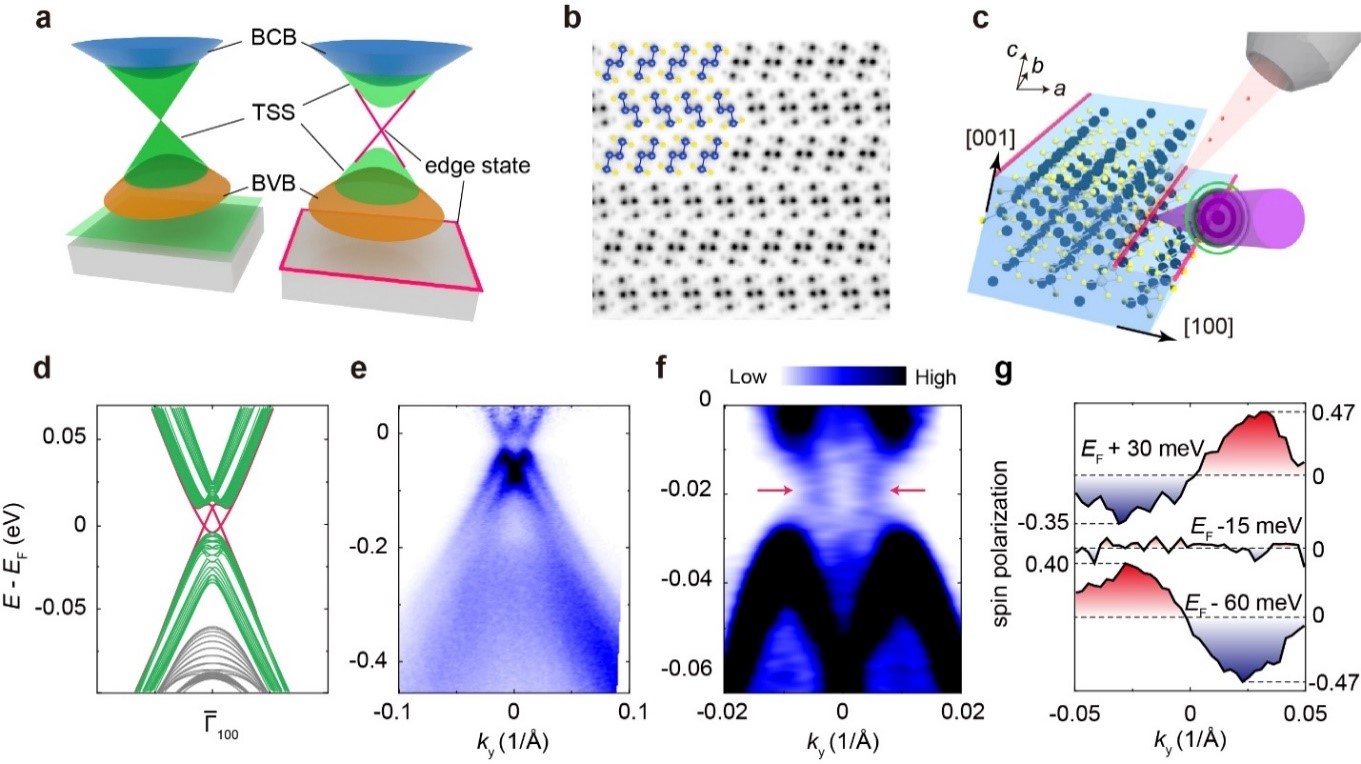
Topological electronic structure and spin texture of quasi-one-dimensional higher-order topological insulator Bi4Br4

Nature Communications 14:8089 (2023)

We systematically investigated the electronic structure of Bi₄Br₄ using advanced sub-micrometer spatial- and spin-resolved ARPES. For the first time, we observed surface states with splitting characteristics on the (100) surface and directly detected a surface state gap. The experiments further revealed the spin-momentum locking nature of these (100) surface states, findings that are in excellent agreement with first-principles calculations. Additionally, the experiments revealed the presence of additional gapless electronic states within the gap of the (100) surface states, indicating the existence of one-dimensional topological hinge states in the system. These results provide compelling evidence for a higher-order topological insulating phase in Bi₄Br₄, establishing it as an ideal material platform for exploring the electronic properties and potential applications of one-dimensional boundary states.
Bi4Br4_HOTI
Learn More

Development of a Laser-based Micro-ARPES with Spin Resolution

Development of a laser-based angle-resolved-photoemission spectrometer with sub-micrometer spatial resolution and high-efficiency spin detection

Review of Scientific Instruments 94, 023903 (2023)

Currently, most micro-ARPES and nano-ARPES systems with high spatial resolution are built based on synchrotron radiation. However, the significant loss of photon intensity upon focusing poses a major challenge for integrating micro-ARPES with spin-ARPES. Here, we developed the first laser-based ARPES system that simultaneously achieves sub-micrometer spatial resolution and high-efficiency spin detection. This system is expected to play a key role in cutting-edge research areas such as low-dimensional quantum materials, phase-separated materials, and in situ measurements of functional electronic devices.
Laser-based ARPES Spectrometer
Learn More

Discovery of Luttinger Liquid phase in higher dimensions

Crossed Luttinger Liquid Hidden in a Quasi-two-dimensional Material

Nature Physics 19, 40 (2023)

Luttinger liquids were thought to exist only in (quasi-)1D systems. Here, we observe Luttinger liquid behavior in η-Mo₄O₁₁. Although the system appears quasi-2D, it is woven from three types of crossing 1D chains with orthogonal orbital characters, which enable weak interchain coupling and protect the Luttinger liquid phase. This discovery marks the first observation of such behavior in a higher-dimensional crystal and offers new insights into non-Fermi liquids in strongly correlated systems.
Quasi-2D Molybdenum Oxide Research
Learn More

Contact Us

Room B233, Department of Physics

Tsinghua University

lxyang@tsinghua.edu.cn
+86-010-6279 0979
© 2024 Tsinghua University Yang Group. All rights reserved.