ARPES Angle-Resolved Photoemission Spectroscopy

ARPES Equipment

ARPES is a pivotal technique for directly probing the electronic structure of solids by resolving the energy and momentum of photoelectrons emitted via the photoelectric effect. By conserving energy and in-plane momentum, it maps band structures, Fermi surface topology, and many-body interactions such as electron–phonon coupling and quasiparticle dynamics. This method has revolutionized the understanding of quantum materials—including high-temperature superconductors, topological insulators, and 2D systems—by revealing their electronic ground states and emergent phenomena.

Laser-ARPES in Tsinghua

Laser-ARPES at Tsinghua

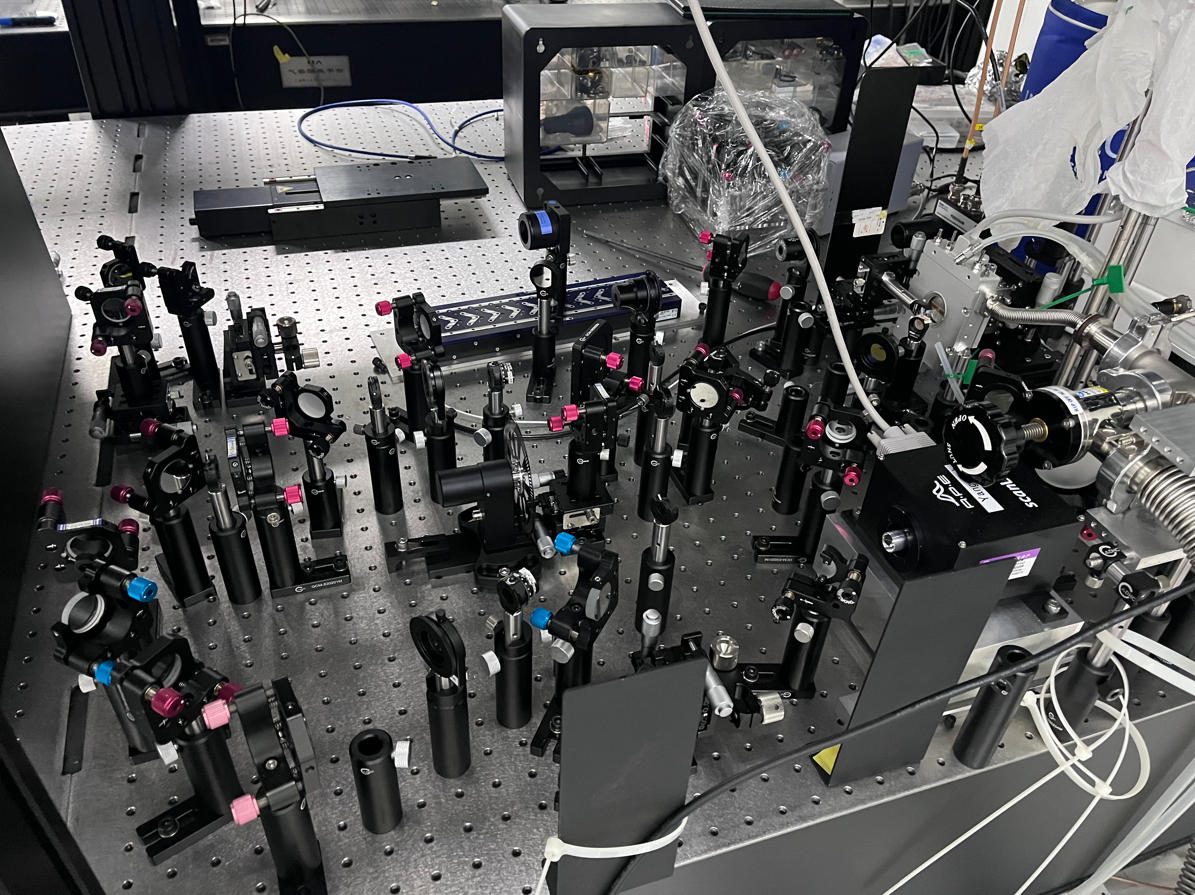
Our laboratory houses state-of-the-art laser-based ARPES systems with ultra-high energy(~ 1.5 meV)and momentum resolution, enabling precise investigation of fine electronic structures in quantum materials. These capabilities allow us to resolve subtle many-body interactions, including electron–electron correlations and electron–phonon coupling, providing critical insights into the emergent phenomena of advanced materials.

Micro-ARPES based on UV Laser in Tsinghua

Micro-ARPES System

Our custom-built micro-ARPES system uniquely combines deep ultraviolet laser sources with sub-micron spatial resolution and high-efficiency spin detection. This capability allows us to probe local electronic structures and spin textures in small samples and spatially inhomogeneous materials with exceptional precision.

MBE Molecular-Beam Epitaxy

MBE System

Molecular Beam Epitaxy (MBE) is a highly controlled thin-film deposition technique used to grow single-crystal materials with atomic precision. In MBE, ultrapure elemental sources are heated in ultra-high vacuum, producing molecular or atomic beams that condense on a heated substrate to form epitaxial layers. The slow deposition rate allows for precise control of thickness, composition, and interface quality, making MBE ideal for fabricating complex heterostructures and quantum materials. Real-time monitoring techniques such as RHEED (Reflection High-Energy Electron Diffraction) enable in-situ growth analysis. MBE plays a crucial role in semiconductor research, quantum devices, and low-dimensional material synthesis.

Ultrafast Spectroscopy Ultrafast reflectivity measurement

Ultrafast reflectivity

Ultrafast reflectivity experiments use femtosecond laser pulses to photoexcite materials and probe the subsequent transient changes in reflectivity. This technique captures carrier dynamics, phonon relaxation, and phase transitions on their native timescales, providing critical insights into nonequilibrium phenomena and quasiparticle interactions.