Nonequilibrium Phenomena

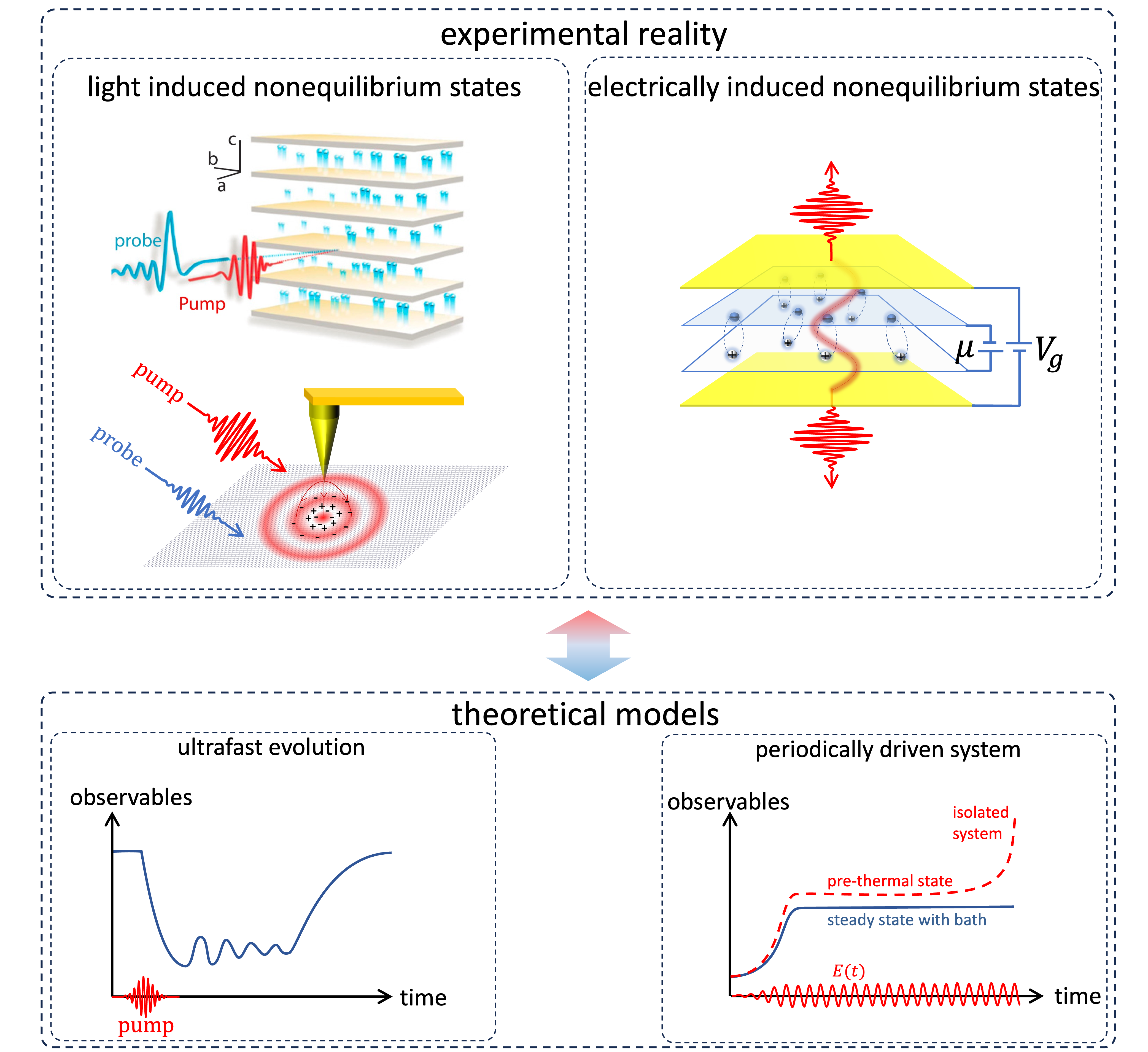
The nonequilibrium phenomena relevant to experiments and real life could be mostly classified as the figure below: those induced by light and those induced by electricity. Electrically induced nonequilibrium phenomena are everywhere in the modern world: light bulbs, LED, laser, computer chips, etc. Light induced nonequilibrium states are more commonly found in cutting-edge experiments. For example, people have found that a laser pulse could transform certain materials into new states.

The theoretical problems from them fall roughly into two categories as in the figure below. One is "ultrafast dynamics", where we would like to know how observables (such as the superconducting gap) evolve in time after the system is excited by a pump pulse (usually an electric field pulse). The other is "periodically driven system" where the system is driven periodically (usually by an oscillating electric field), and we would like to know the property of its steady state.
Predicting steady states via the ponderomotive potential
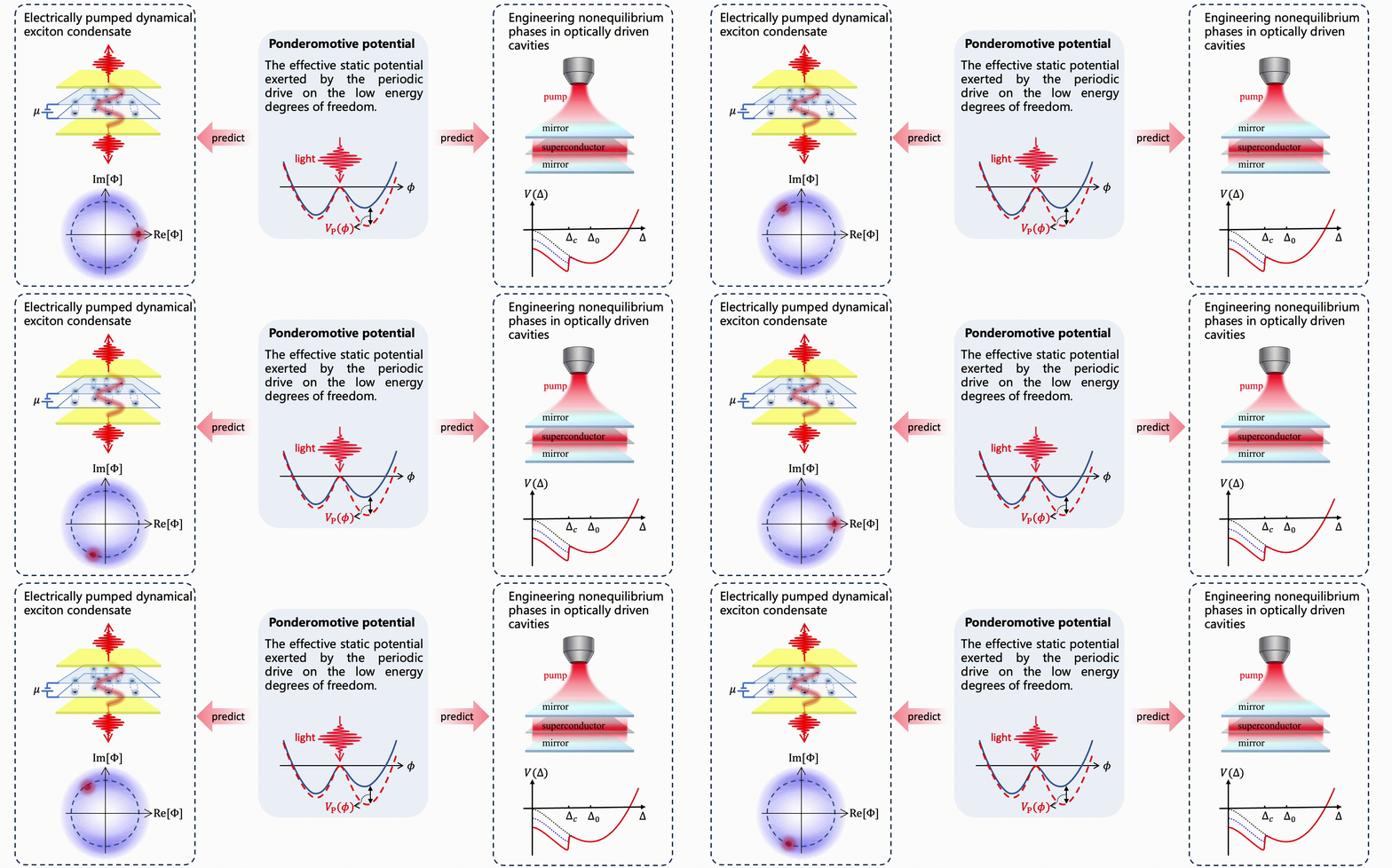
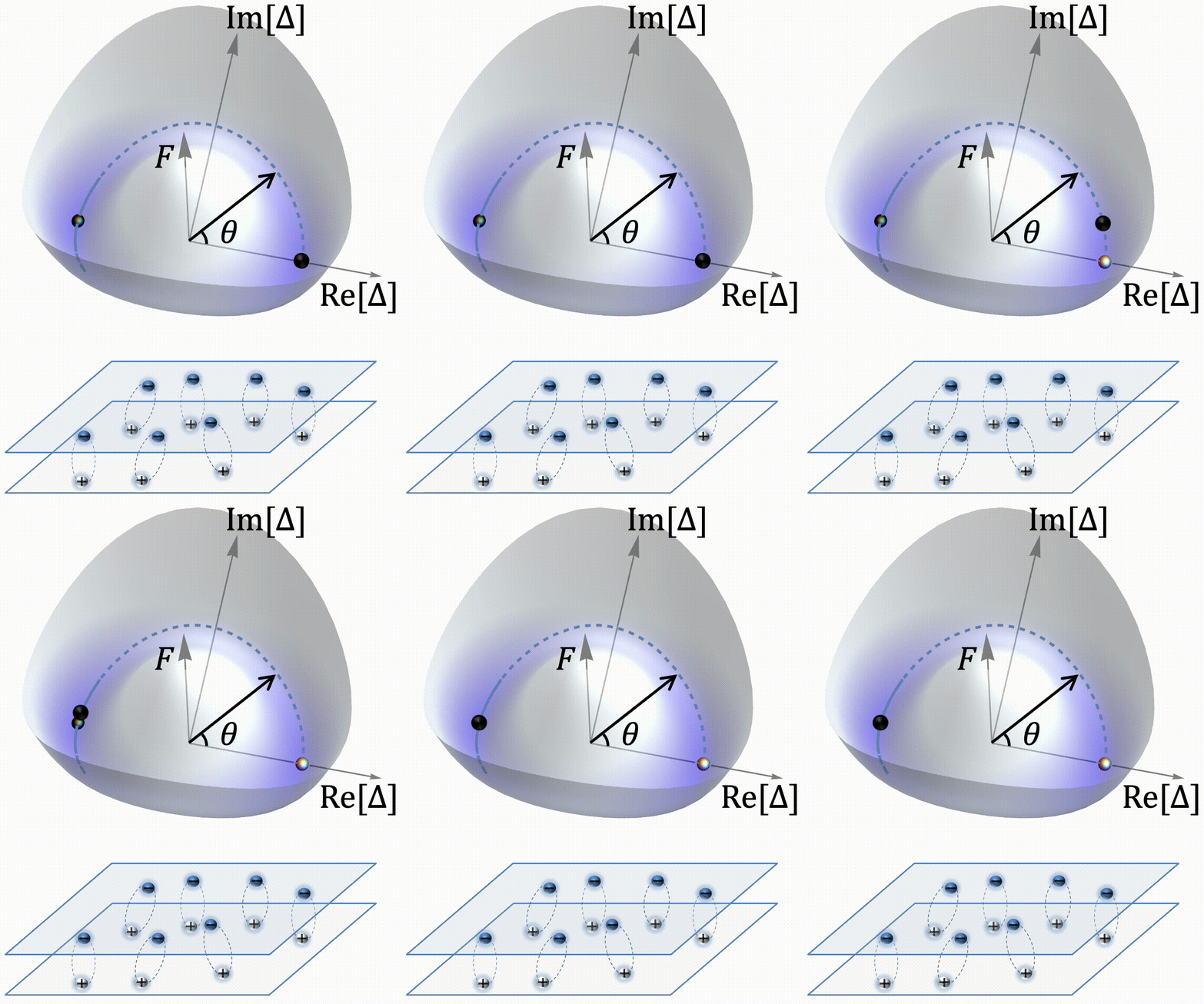
An optical tweezer could trap small objects such as a living cell or an atom using a laser beam. The trapping force from the laser beam is an example of the "ponderomotive force". In [PRB 110, 104301 (2024)], we formulated the ponderomotive force felt by the collective slow degrees of freedom in quantum many-body systems driven by incident light. It is defined as the effective static force exerted by the drive on the low energy degrees of freedom. By minimizing the potential landscape modifed by this force (see figure below), one may predict the steady state of a periodically driven system efficiently and intuitively. For example, when a piece of metal is illuminated by light, this force may stabilize it in a superconducting state, a state with zero electrical resistance. Similarly, light shined on a semiconductor creates a ponderomotive force that could induce a superfluid made of excitons.

The ponderomotive force was latter used to predict the nonequilibrium steady state called "dynamical exciton condensates" in electrically biased (or optically pumped) devices [PRL 133, 217002 (2024)]. We explored a bilayer device made by stacking two ultra-thin semiconductors, see the left panel of the figure above. If one attaches a lead to each layer and applies a voltage bias between them, electrons are injected into one layer, while positively charged particles called "holes" are injected into the other. Electrons and holes can then pair up to form excitons, just like how an electron and proton combine to form a hydrogen atom. At very low temperatures, these excitons can condense into a Bose-Einstein condensate—a macroscopic quantum state that may flow without friction. We revealed that this device is not static but is actually constantly evolving, much like a spinning fan. The exciton condensate can exist in a "bright" state, emitting coherent light, or a "dark" state with oscillating electrical currents, same as the AC Josephson effect. From the ponderomotive force, we found that the bias voltage could tune the device to switch between these states. Remarkably, when placed in an optical cavity, the device may enter a "super-radiant" state, boosting photon emission by up to a hundredfold. The device may function as a nano-laser that could be integrated into cell phones in the future.

The ponderomotive force is also useful in engineering quantum materials in an optically driven cavity, a cavity driven by external pump light (right panel of the figure above). There a universal step-like ponderomotive potential induces phase transitions of matter [PRL 136, 036901 (2026)]. In a representative design, a thin superconducting film sits in such a cavity made of two mirrors. When a laser shines into the cavity, the trapped light reshapes the material’s internal energy landscape and pushes the system into a different state, much like water suddenly turning to ice. The new state is a weaker superconductor but becomes “super-radiant”, meaning that the cavity stores many more photons than before. The key idea is that the incoming light exerts an effective push on the material’s configuration (not in real space but in the space of possible internal states), and the cavity turns that push into a step-like potential that triggers an abrupt switch. Because this mechanism relies on generic light–matter coupling, it could work for many materials, suggesting a universal route to ultrafast memory and logic elements for future photonic computers.

Formally, we have been studying the effective action of the low energy degrees of freedom in these periodically driven systems. This effective action is most conveniently expressed in the language of Keldysh action. The ponderomotive potential is the (drive contributed) static potential felt by the slow degrees of freedom. In addition to the ponderomotive potential, the drive also leads to nonequillibrium fluctuation and dissipation terms in the effective action. Currently, we have been exploring these effective field theories for nonequillibrium pheonemena.

Order parameter steering
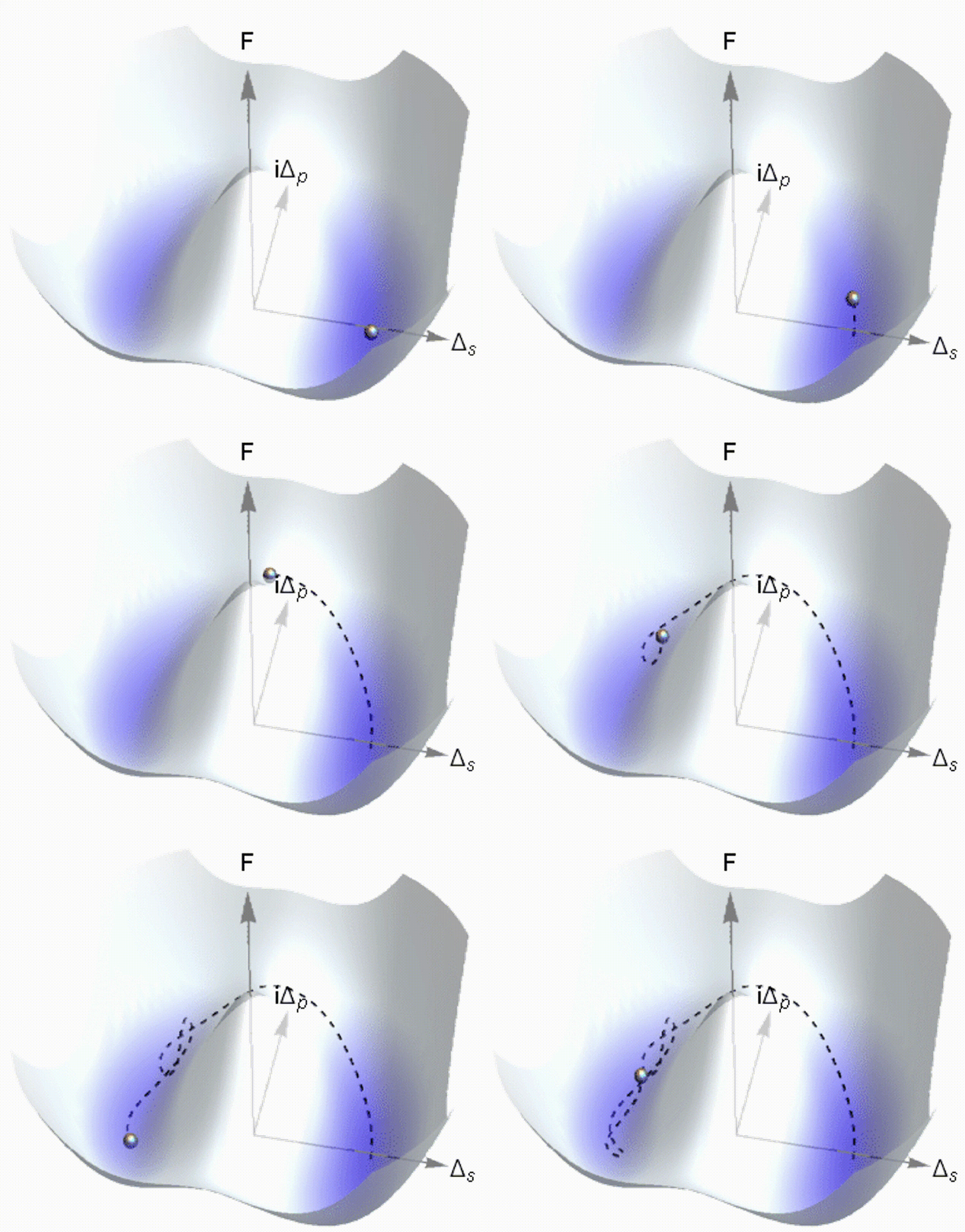
There is a widespread phenomenon in ultrafast pump probe experiments: light pulses can transform a system from one phase to another. This calls for efficient theoretical descriptions. “Light induced order parameter steering” is a notion that serves this purpose.
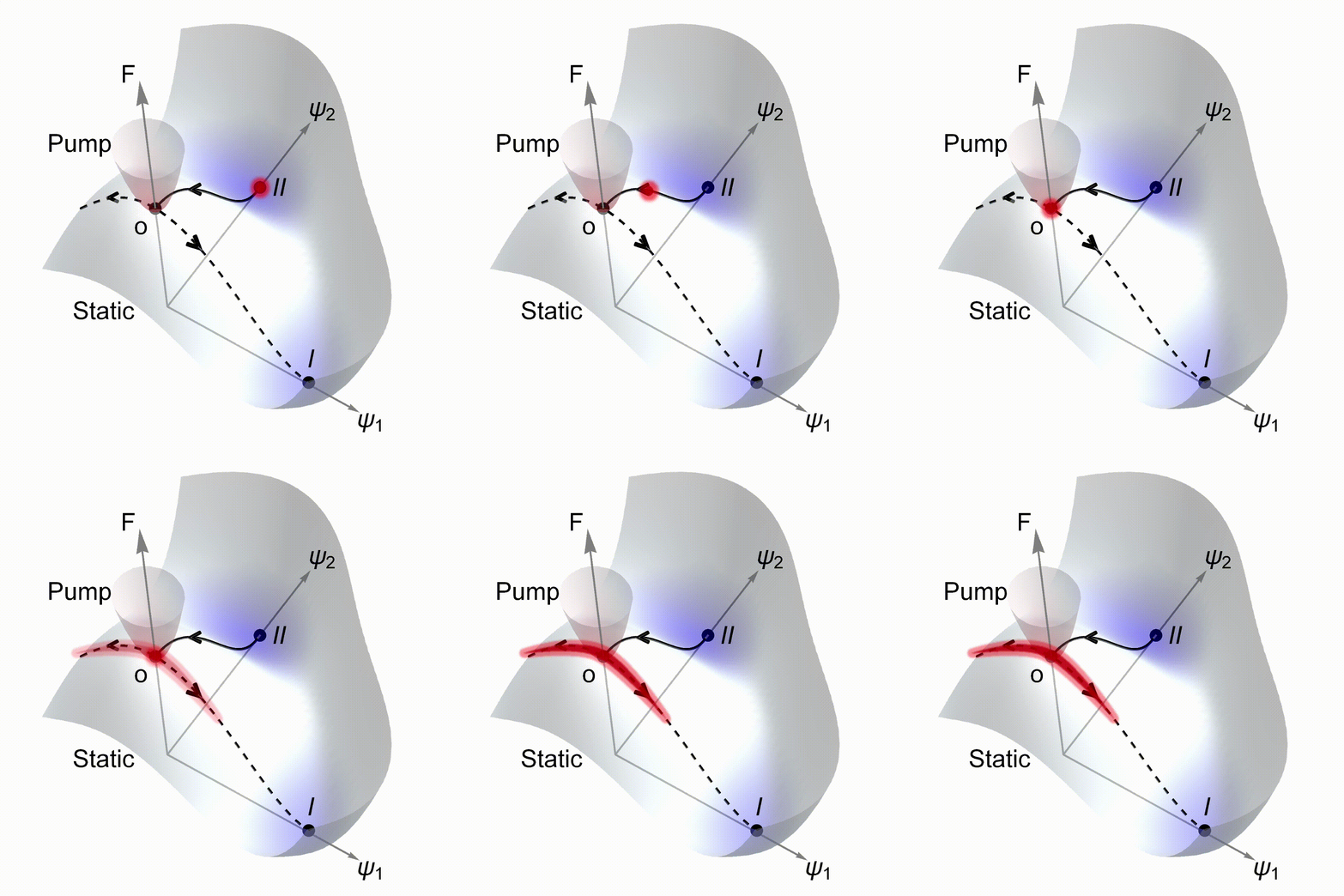
The simples order parameter steering is lead by the dynamics of its spatially uniform mean field. If you want a light pulse to steer the order, the most natural systems is the excitonic insulator, a long range ordered state made of electron-hole pairs. At the linear response level, a weak light pulse can excite a novel collective mode coined ‘BaSh polariton‘ [PRB 102, 041110(R) (2020)]. A strong light pulse leads to nonequilibrium effect: it may drive the order parameter to evolve along a topologically nontrivial trajectory, realizing a Thouless charge pump as a collective manybody effect [PRL 126, 027601 (2021)], see figure to the right. Light can also steer the phase of the excitonic order parameter. In electron-hole bilayers where charge can tunnel between the two layers, the excitonic order is accompanied by a second order Josephson effect [PRL 127, 127402 (2021)]. This means that the system has two degenerate ground states, and can be switched between them either by an interlayer voltage pulse or by a light pulse polarized out-of-plane.
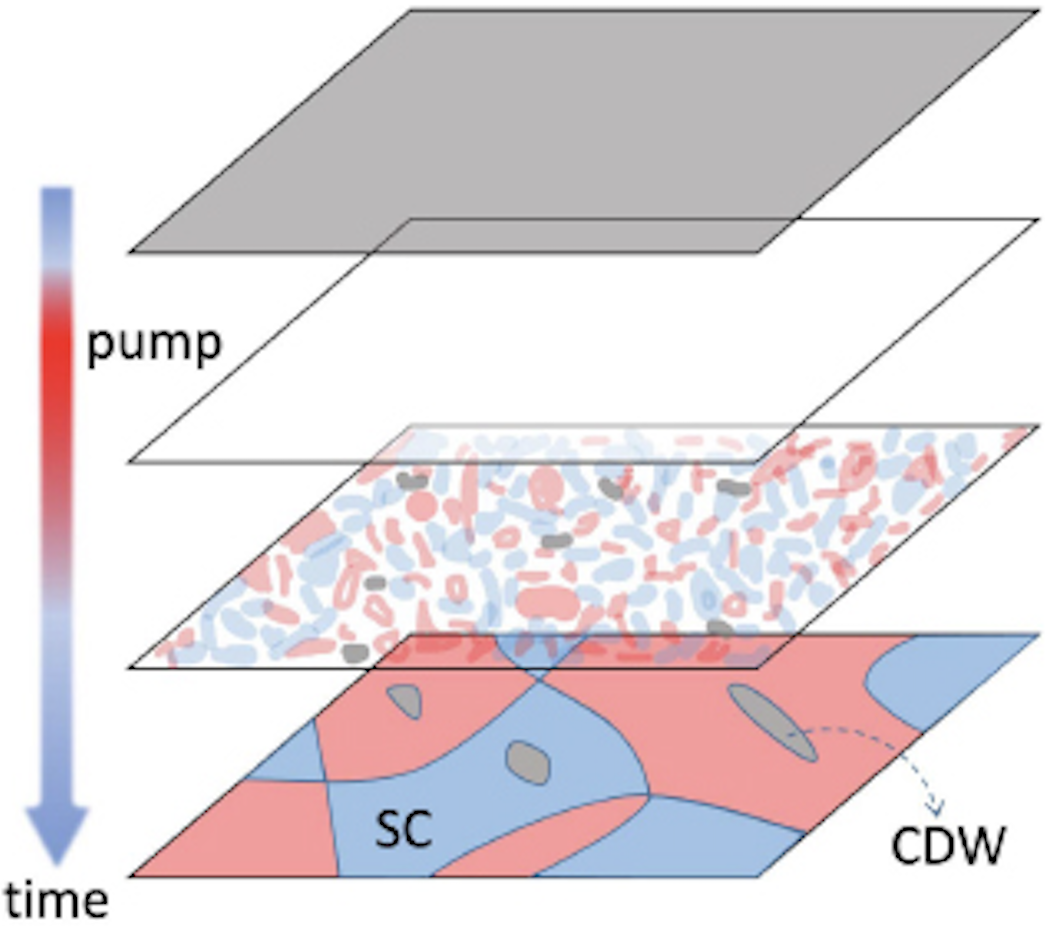
Order parameter steering may also be lead by spatial-temporal fluctuations [PRX 10, 021028 (2020)]. In systems with competing orders, the pump pulse often heats up the electronic system and destroys the dominant order. Subsequently, the electronic system quickly cools down by dumping heat into the lattice. In the cooling process, order parameter fluctuations would grow exponentially. If there is a hidden order that has a faster dynamics than the dominant one, the “fluctuation explosion” process will drive the system to a metastable hidden phase, see right figure. It explains the widespread experimental observation that metastable states may be induced by laser-induced collapse of a dominant equilibrium order parameter. The light induced metastable states observed in experiments include magnetism, sub-dominant charge orders, superconducting-like states, etc.
Fluctuation growth
Fluctuation in real space
PRX 10, 021028 (2020)


Polaritons and Linear/Nonlinear/Quantum Optics

We investigate polaritons and other collective excitation in close collaboration with experimentalists. These collective modes and the linear/nonlinear optics associated with them are the natural first step toward understanding light-induced nonequilibrium phenomena.

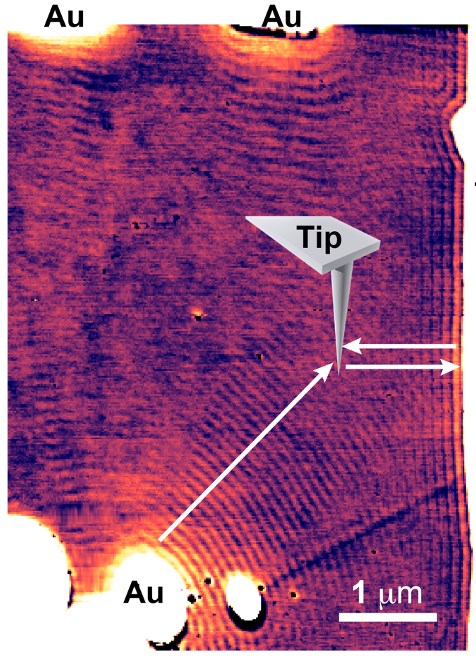
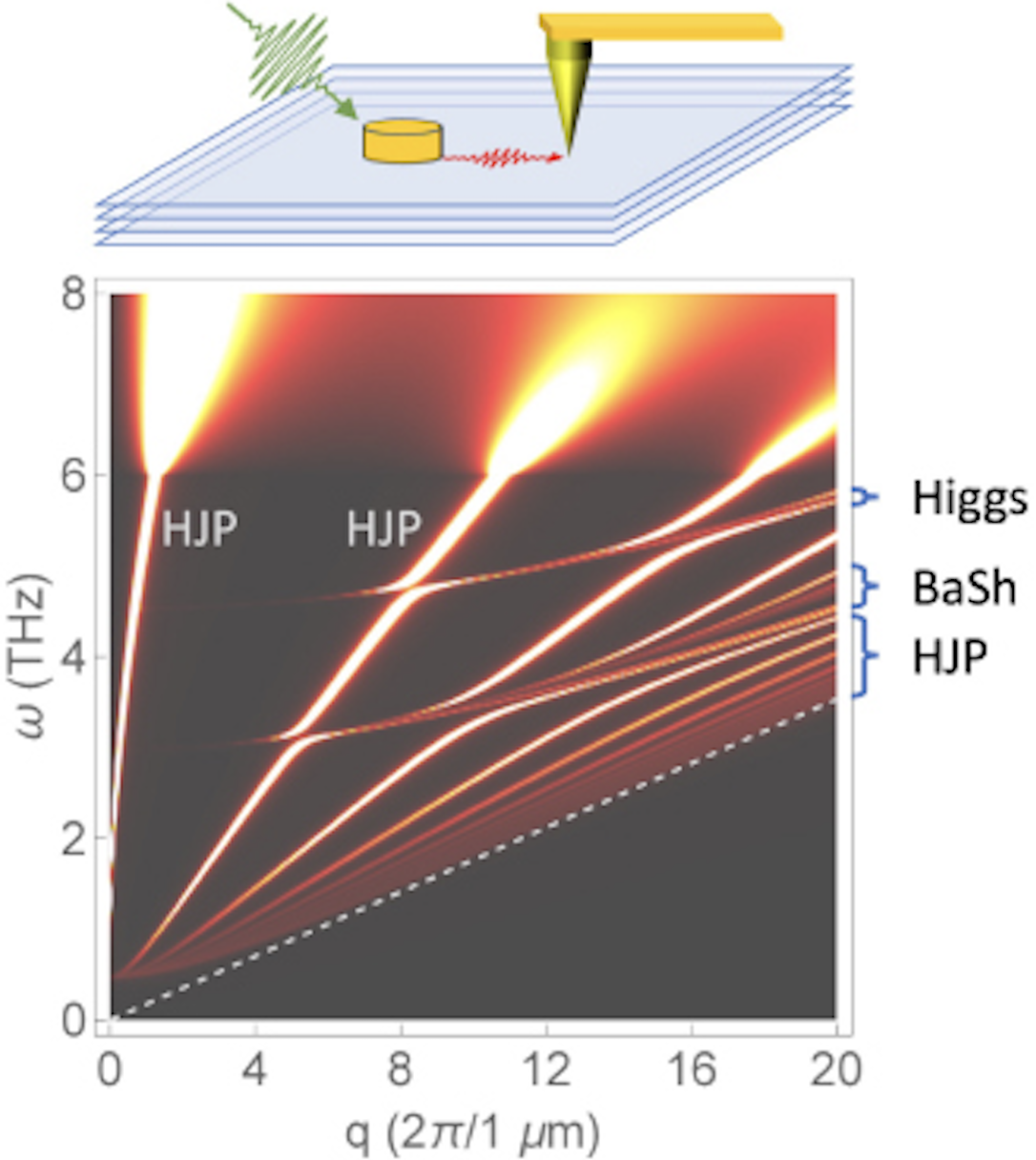
Collective excitations refer to oscillations of certain collective degrees of freedom in materials. Each degree of freedom resembles a harmonic oscillator and thus forms a bosonic mode. In metals, electrons can oscillate collectively, giving rise to plasmons. Atoms can vibrate collectively, corresponding to phonons. In semiconductors, the creation and annihilation of electrons and holes can occur in a coherent manner like vibrations, forming excitonic excitations. In materials, these collective excitations are often hybridyzed modes between matter vibrations and photons, and are named "polaritons". The right two figures show scanning near-field optical microscopy (SNOM) images of plasmons in graphene, and a theoretical plot of some collective excitations in a superconductor.


Graphene plasmon
Collective excitations
Near field imaging of graphene plasmons. Figure from [Nature 557, 530 (2018)].
Collective modes of superconductors showing up in the near field reflection coefficient [PRR 2, 023413 (2020)].
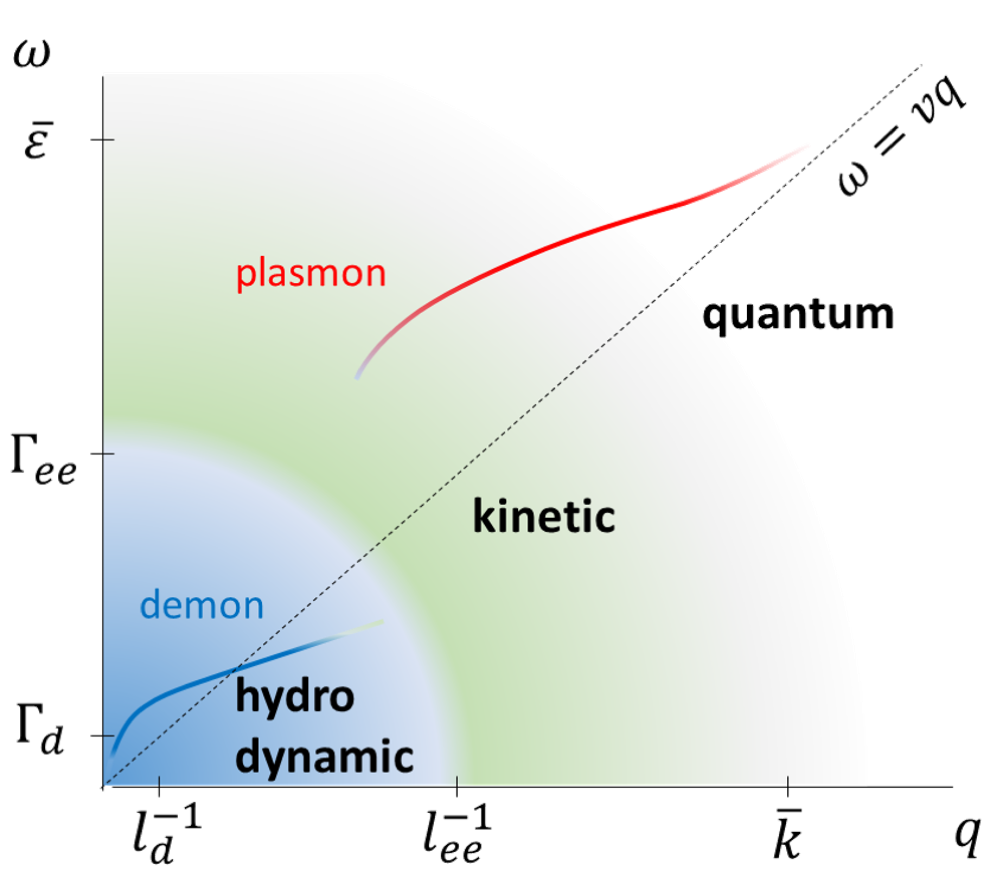
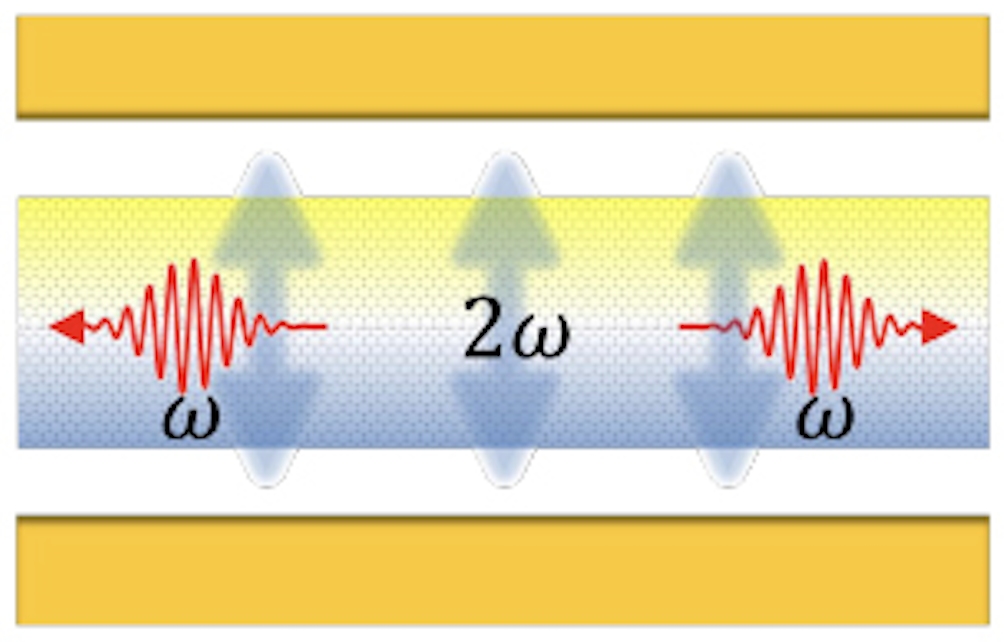
The dielectric function, familiar to many, characterizes the linear optical response of a material. As a response function, it is a fundamental observable in condensed matter physics, widely used to probe electronic structure and many-body properties. It also governs the behavior of electromagnetic waves inside the material: polaritons. The nonlinear optical properties of a material govern the interactions between these polaritons. Such effects enable applications including photovoltaic devices, high/difference frequency conversion, and parametric down-conversion for classical and quantum information technologies. The top right figure shows the different regimes of electromagnetic response in a Dirac fluid, e.g., electron fluid in graphene. The bottom right figure illustrates a nano scale quantum light source that exploits the nonlinear optical properties of graphene to generate entangled plasmons.